
Right Place, Right Time.
For decades, the narrative of boarding school life followed a predictable pattern: students arrive in their 9th grade year, acclimating to rigorous academics while also navigating communal living, gradually becoming a cohesive cohort that remains unchanged until graduation. Notably, the idea of “youth who switch schools are more likely to … perform worse academically” was a major misconception that some families may have fostered, encapsulating the notion that switching schools ultimately disrupts the flow of learning and cultivates instability (National Institutes of Health). However, in the post-COVID era, boarding school campuses look different from what we used to view as the “traditional” path, revealing a distinct shift in ideals of what high school should look like. Along with the class of incoming 9th graders, 24 new 10th graders, 25 new 11th graders, and 10 new 12th graders begin their high school chapters in an entirely new environment at Stevenson. Far from resembling a random anomaly, the increase in upper school transfers reflects an even broader, national shift in how families approach education.

The years following 2021 heavily shifted the perspective students and families have when it comes to learning environments. The pandemic disrupted traditional educational pathways, forcing families and students to re-evaluate what they truly think matters in a high school experience, as well as schools—especially boarding—ensuring
seamless transitions back into school. Today’s upperclassmen transfers make deliberate choices to switch schools, rather than viewing a mid-highschool transfer as a disruption. Families increasingly see it as an intentional search for a better environment and campus community. According to k12.com, families prioritize the environment that their child is able to thrive in, despite what used to be the primary consideration of academic rigor and college matriculation. At Stevenson, this means new students arrive on campus looking for opportunities to be involved, integrate into the community, and, ultimately, to feel that the environment is the best place to thrive. Victoria Zuniga ‘28 states, “I came to Stevenson to try new things I haven't done before, and to meet people from all different types of backgrounds.” Choosing to transfer for 11th or 12th grade is no longer stigmatized as starting over, but rather stepping up to an environment that matches a student’s desired learning career.
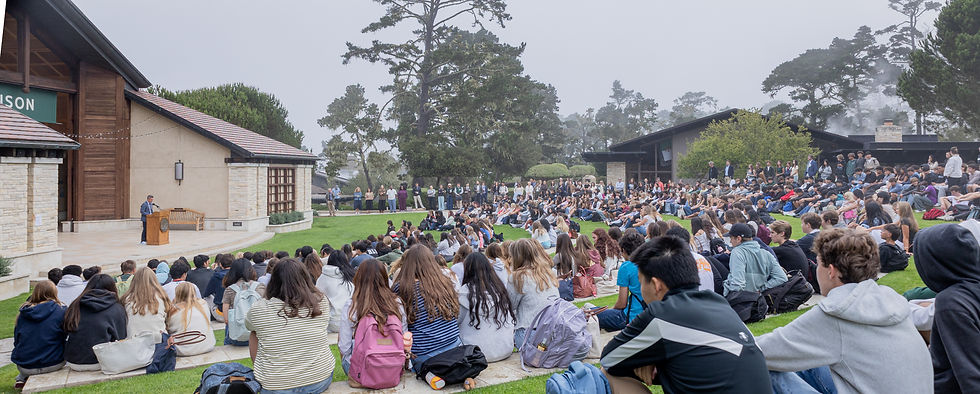
This influx of upperclassmen transfers changes the dynamic of campus life—in fact, it’s an advantage for a better school environment overall. Welcoming new upperclassmen allows for fresh perspectives within the classroom and even the dormitories. In the critical few years that students have at any high school, every moment matters—at a boarding school, this means being involved as much as you can and contributing meaningfully. With the highest number of boarding students Stevenson has had in a while, along with the size of the new cohort of students across all four grades, the school has gained an increasingly diverse student body. There are a variety of reasons behind students’ decisions to come to Stevenson during the middle of their high school years, but more importantly, each student shares a common denominator when it comes to finding the right place for them to excel in. Director of Enrollment Management Amy Graham strongly believes that “students who come to Stevenson can find success, areas of comfort, but also areas of growth.” Graham continues, “students are open to taking risks and trying out new things in different spaces on campus.” Instead of facing their final years of high school being afraid to take on new challenges, students are eager to contribute meaningfully.
The evolving demographic of the Stevenson student body mirrors the reality of a student’s high school years: the environment a school provides for its students often outweighs the academic rigor and misconceptualized idea of a traditional high school path that once dictated where families send their children.


Comments