
Escape the Loop: A Review of Exit 8

Updated: Aug 11
Despite its mundane summary describing “strange events [that] plague a young man as he searches for the exit in an endless subway tunnel,” the Japanese Horror film Exit 8 proved to be a powerful social commentary. But, before we dive into the analysis, I will offer a spoiler alert to those who want to see this cinematic masterpiece for themselves.
The film’s establishing shot introduces the notion of uniformity on rush-hour Japanese subway as a crying baby ignites a fight between his mother and an angry man. Bystanders, particularly the protagonist whose sole name is “Lost Man,” choose to continue scrolling rather than engage with the injustice presented before them. This passive behavior emerges as a potent symbol for modern distraction culture enabled by technology—think the doomscrolling that turns human crises of mass proportion into content that we can overlook with the swipe of a thumb.
As he searches for Exit 8, he finds himself stuck in an endless loop, passing exits numbered 1 through 8, until he reads a sign telling him to turn back if he finds terrifying distortions in the environment called anomalies. It is only by being present, in discovering what is wrong with his surroundings that he is able to proceed to the next level.
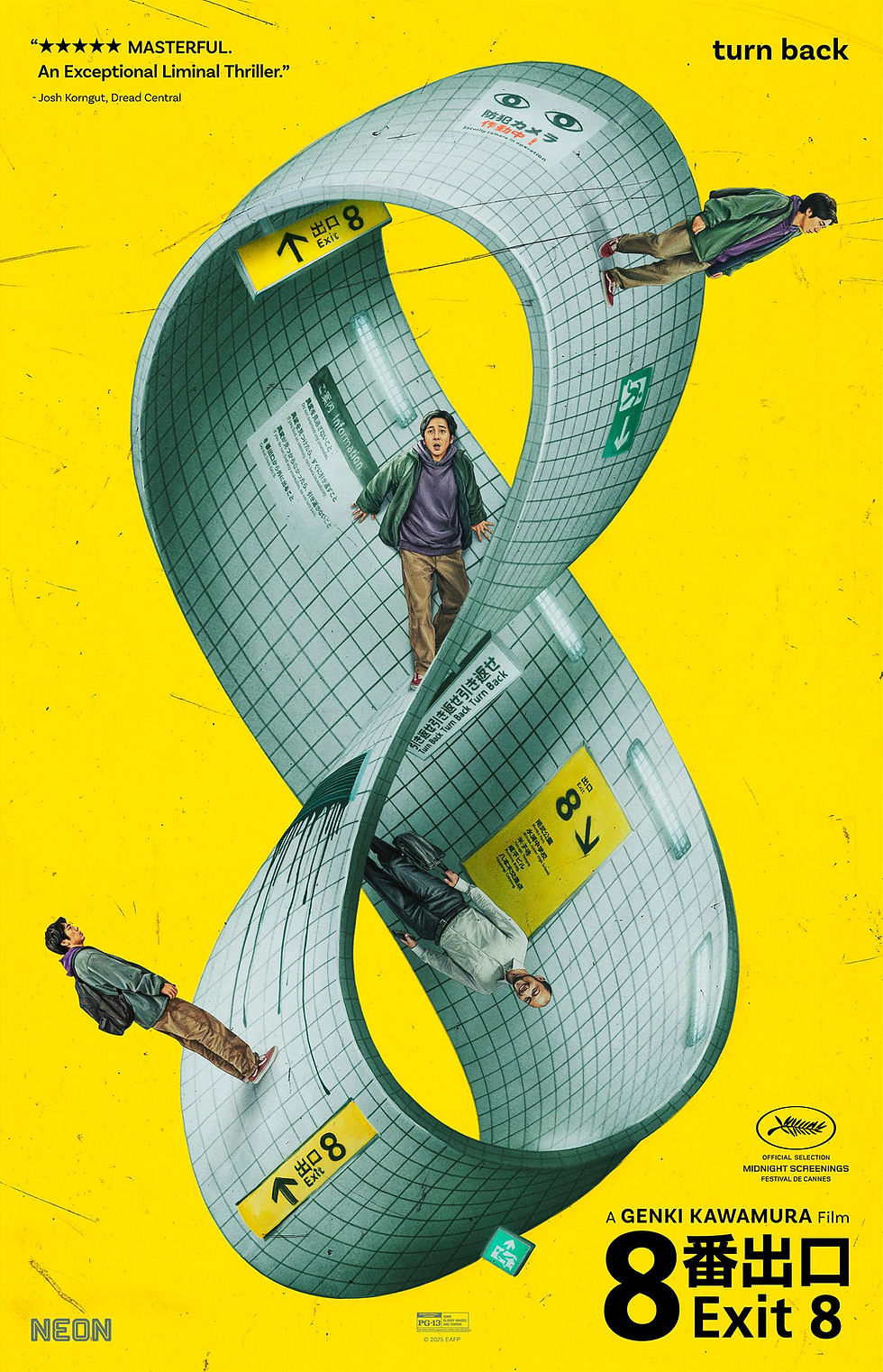
The movie’s next character is a curious boy who easily senses the anomalies. Once attached to the “Walking Man” who functions as a twisted father figure, The Boy tries to guide him toward safety. The relationship introduces a generational dynamic analogous to the GenZ and Millennials relationship with the Baby Boomers in power: by ignoring The Boy’s warnings and trusting his own conventional understanding, he dooms himself to become a character trapped in the game.
The Boy eventually encounters the Lost Man, who has just learned he is going to become a father and is quietly testing whether he is worthy of that role. Unlike the Walking Man, the Lost Man treats the Boy with genuine kindness, reading and respecting his silent cues. By ultimately choosing the Boy’s safety over his own, he proves his capacity for listening to the younger generations and enables both of them to escape the loop.
The child stands at a fork in the road, the “Walking Man” and “Lost Man” as the two separate paths for our collective future. Should we be complacent and rely on “conventional” knowledge, we will doom ourselves and those who follow to inherit a world shaped by our willful ignorance. Should we be present and engage with injustice—the anomalies of climate change and grave inequality, for example—maybe we can change course and chart a sustainable path to the future.


Comments